
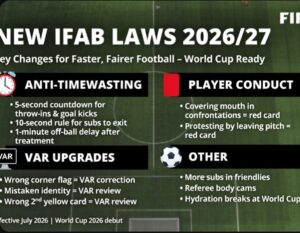
The International Football Association Board (IFAB) has just unveiled the Laws of the Game 2026/27, with the changes taking full effect from 1 July 2026. Many of the headline updates are already being rolled out for the 2026 FIFA World Cup (kicking off 11 June in the USA, Canada, and Mexico). The overarching goals? Cut time-wasting, boost match tempo, crack down on poor player behaviour, and give referees better tools for consistency.
These aren’t minor tweaks—they’re the biggest shake-up in years. Here’s your complete, fan-friendly breakdown of the key new rules.
1. Anti-Time-Wasting Crackdown (The Big One)
Football has been getting slower for years. IFAB is fighting back with visible, enforceable clocks:
- 5-second visual countdown for throw-ins and goal kicks
Referees will show a clear countdown. Miss the deadline?
- Throw-in → awarded to the opposing team.
- Goal kick → becomes a corner for the opposition.
- 10-second substitution rule
Subbed players now have just 10 seconds to leave the pitch via the nearest boundary line. Dawdle? The replacement can’t enter until the next stoppage after one full minute.
1-minute off-pitch treatment rule
Outfield players who get treatment (or cause a stoppage due to injury) must stay off the field for at least one minute once play restarts. Exceptions: goalkeepers, head injuries/concussions, collisions involving both teams, or penalty situations. No more “tactical injuries” for team talks.
Tactical timeouts banned
Referees will actively stop teams using fake injuries to regroup or coach from the sidelines.
World Cup bonus: Mandatory 3-minute hydration breaks in each half (with referee flexibility for extreme heat or flow).
2. Stricter Conduct Rules – Red Cards for Bad Behaviour
IFAB is drawing a firm line on dissent and hidden abuse:
Red card for covering your mouth during confrontational situations (hand, arm, or shirt). Friendly chats are fine—this targets players hiding abuse or instructions to officials.
Red card for walking off the pitch in protest at a referee’s decision. Team officials encouraging this also risk red cards. If a team causes abandonment through repeated behaviour, they forfeit the match.
These changes aim to protect referees and stop the ugly scenes we’ve seen too often.
3. VAR Gets More Power (But Still Controlled)
VAR is evolving to fix obvious errors faster:
- Can now review and overturn wrongly awarded corner kicks (competition option, only obvious errors, no delays).
- Reviews for incorrect red cards from a clearly wrong second yellow.
- Mistaken identity incidents (wrong player booked/sent off).
VAR can also look at fouls committed before the ball is in play at set-pieces (e.g., blocking a defender before a corner).
4. Other Notable Changes
- More substitutes in senior ‘A’ international friendlies: Up to 8 (or 11 if both teams agree).
- ‘Only the captain’ protocol becomes compulsory for all competitions from July 2027.
- Referee body cameras now allowed as an optional competition tool.
- Minor tweaks to dropped balls, penalty double-touch rules, DOGSO advantage, and equipment (non-dangerous covered accessories are now explicitly OK).
Why These Changes Matter
The message from IFAB and FIFA is clear: football should be faster, more entertaining, and played in the right spirit. Pierluigi Collina, FIFA’s chief refereeing officer, summed it up perfectly: referees will no longer tolerate teams using injuries as tactical timeouts.
Expect sharper, more continuous matches at the World Cup and beyond. Players and coaches will need to adapt quickly—especially to those visible countdown clocks.
What Fans Can Expect at the 2026 World Cup
- Fewer stoppages
- More goals from quick transitions
- Cleaner conduct (or instant red cards)
- Technology helping referees get the big calls right
The beautiful game just got a much-needed refresh.
These rules are designed to make the game better for everyone—players, fans, and officials alike.
About the Author